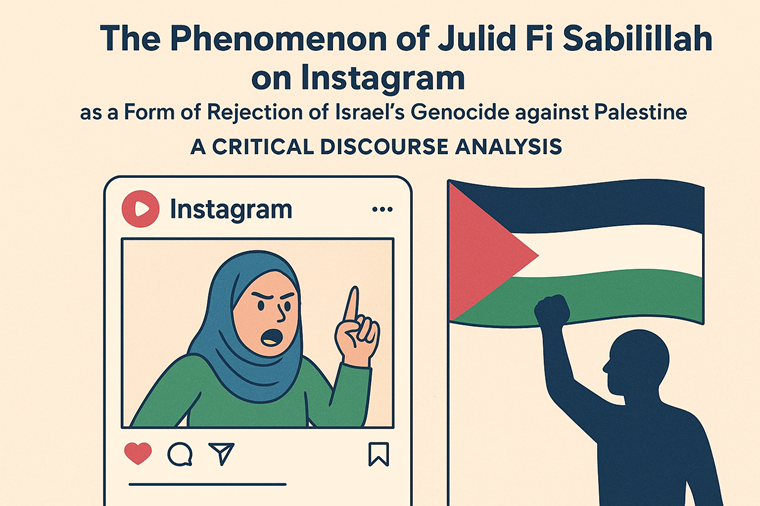
The Phenomenon of Julid Fi Sabilillah on Instagram as a Form of Rejection of Israel's Genocide against Palestine: A Critical Discourse Analysis
Abstract
Julid Fi Sabilillah emerged as a response to the massive genocide by Israel that began on October 7, 2023. This research aims to unveil the phenomenon of Julid Fi Sabilillah on Instagram using a critical discourse analysis approach and to explain its role and influence regarding the genocide committed by Israel against Palestine. The methodology employed in this study is qualitative, utilizing Norman Fairclough's critical discourse analysis model. The findings indicate that the phenomenon of Julid Fi Sabilillah on Instagram represents an effort by pro-Palestinian Indonesian citizens to resist Israel, triggered by the genocide that started on October 7, 2023. This is manifested through comments and posts laden with protests against Israel and calls for public participation. Julid Fi Sabilillah plays a role in undermining the morale of IDF (Israel Defense Forces) soldiers and countering their propaganda on social media, causing stress and disruption that leads them to lock and limit their Instagram accounts.
References
Al Jazeera English. (2024). Israel's war on Gaza [Instagram post]. Instagram. https://www.instagram.com/p/C7l9-yrMfbe/?igsh=MXB6eTg4OHBrbWs0Zg
Annur, C. M. (2023, November 28). Indonesia is the 4th-most Instagram-using country in the world, according to Databoks. Databoks. https://databoks.katadata.co.id/datapublish/2023/11/28/indonesia-jadi-negara-dengan-pengguna-instagram-terbanyak-ke-4-di-dunia
Asosiasi Penyelenggara Jasa Internet Indonesia (APJII). (2024). Number of Indonesian internet users reached 221 million. https://apjii.or.id/berita/d/apjii-jumlah-pengguna-internet-indonesia-tembus-221-juta-orang
Astri, N. D., Sinambela, P. J., & Purba, A. Y. (2020). Imperative sentences in the Toba Batak language of Mela Village, Tapian Nauli District, Central Tapanuli Regency. Asas: Journal of Literature, 9(2), 111–123. https://www.academia.edu/download/84370544/21622-48214-1-SM.pdf
Caesareka, Y. W., & Nugroho, C. (2020). Commodification of religion in fashion products (Norman Fairclough’s critical discourse analysis of “Keepers of the Deen” sweatshirt design). LONTAR: Journal of Communication Science, 8(2). https://doi.org/10.30656/lontar.v8i2.2526
Cahyono, A. S. (2016). The influence of social media on social change in Indonesia. Journal of Publiciana, Faculty of Social and Political Sciences, 9(1), 140–157. https://repository.unita.ac.id/index.php/items/show/204
Cintya, B., Ernanda, E., & Triandana, A. (2022). Women’s resistance to nature-destroying corporations in the documentary film Tanah Ibu Kami: Norman Fairclough’s critical discourse analysis approach. Linguistic and Literary Studies, 1(2), 237–256. https://doi.org/10.22437/kalistra.v1i2.20306
Creswell, J. W. (2014). Research design: Qualitative, quantitative, and mixed methods approaches (4th ed.). SAGE Publications.
Fairclough, N. (1989). Language and power. New York, NY: Longman.
Fairclough, N. (1995). Critical discourse analysis. Linguistics and Education, 4(3–4), 269–293.
Greschinov, E. (2024). Julid fi sabilillah. South Jakarta: Reenebook.
Haryatmoko. (2019). Critical discourse analysis: Theoretical foundations, methodology, and bleeding (3rd ed.). Depok: PT Raja Grafindo Persada.
Ismail, S. (2008). Critical discourse analysis: An alternative to analysing discourse. Unimed Language Journal, 69(35). https://doi.org/10.24114/bhs.v0i69TH%20XXXV.2430
Isna, F. N., Mumtaz, T. Z., Setyawati, E., & Wahyuni, L. (2023). Indonesian citizens’ struggle against Israeli genocide against Palestine through declarative acts on Twitter social media. Multiverse: Open Multidisciplinary Journal, 2(3), 338–345. https://doi.org/10.57251/multiverse.v2i3.1189
Muhid, H. K., & Andryanto, S. D. (2023). Profile of the Israel Defence Forces (IDF), the Israeli military led by Defence Minister Yoav Gallant. Tempo Dunia. https://dunia.tempo.co/read/1795098/profil-israel-defence-forces-atau-idf-militer-israel-pimpinan-menhan-yoav-gallant
Munfarida, E. (2014). Critical discourse analysis from the perspective of Norman Fairclough. KOMUNIKA: Journal of Da’wah and Communication, 8(1), 1–19. https://doi.org/10.24090/komunika.v8i1.746
Rohana, & Syamsuddin. (2015). Discourse analysis. Makassar: Samudra Alif Mim.
Samsuri, A., Mulawarman, W. G., & Hudiyono, Y. (2022). The ideology of using COVID-19 terms in online news: A critical discourse analysis of Norman Fairclough’s model. Diglosia: Journal of Language, Literature, and Teaching Studies, 5(3), 603–618. https://doi.org/10.30872/diglosia.v5i3.442
Saputra, T. W. (2024). Hassan Bin Tsabit Brigade: Indonesian netizens in social media war to support Palestine. Journal on Education, 6(2), 13,172–13,184. https://doi.org/10.31004/joe.v6i2.5174
Supriyadi. (2015). Critical discourse analysis: Its concept and function for society. Aksara, 16(2).
Sweet, P. L. (2019). The sociology of gaslighting. American Sociological Review, 84(5), 851–875. https://doi.org/10.1177/0003122419874843
Tindangen, E., D. S. M., & Wauran, P. C. (2020). The role of women in improving the family economy (Case study: Women rice field workers in West Lemoh Village, East Tombariri District, Minahasa Regency). Journal of Efficiency Scientific Periodicals, 20(3).
Yuhandra, M. G., Nugraha, T. C., & Lukman, F. (2024). Ideology of Al Jazeera Arabic in the news discourse of Saudi Muhammad bin Salman’s vision (Fairclough model discourse analysis). Diglosia: Journal of Language, Literature, and Teaching Studies, 7(1), 9–24. https://doi.org/10.30872/diglosia.v7i1.808
Zaim, M. (2014). Language research methods: A structural approach. Padang: FBS UNP Press.

This work is licensed under a Creative Commons Attribution-ShareAlike 4.0 International License.
Copyright
- The Author and each co-authors transfer the copyright and grant the journal right of publication with the work simultaneously licensed under an International Creative Commons Attribution and ShareAlike 4.0 License that allows others to share the work with an acknowledgement of the work's authorship and initial publication in this journal.
- Authors are able to enter into separate, additional contractual arrangements for the non-exclusive distribution of the journal's published version of the work (e.g., post it to an institutional repository or publish it in a book), with an acknowledgement of its initial publication in this journal.
- Authors should sign copyright transfer agreement when they have approved the final proofs sent by ISLAMIC RESEARCH prior the publication.
Author Guarantee
- The Author (Co-authors) guarantees that the Materials are an original work, submitted only to ISLAMIC RESEARCH, and have not been published previously.
- In case the Materials were written jointly with Co-authors, the Author guarantees that he/she has informed them of the terms of this Agreement and obtained their signatures or written permission to singe on their behalf.
- The Author guarantees as well that:
- The Materials do not contain libelous statements.
- The Materials do not infringe on other persons' rights (including without limitation copyrights, patent rights and the trademark right).
- The Materials do not contain facts or instructions that can cause damage or injury to third parties and their publication dose not cause the disclosure of any secret or confidential information
ISLAMIC RESEARCH is Published by Perhimpunan Intelektual Muslim Indonesia, and licensed under a Creative Commons Attribution-ShareAlike 4.0 International License.
Copyright ©2022.