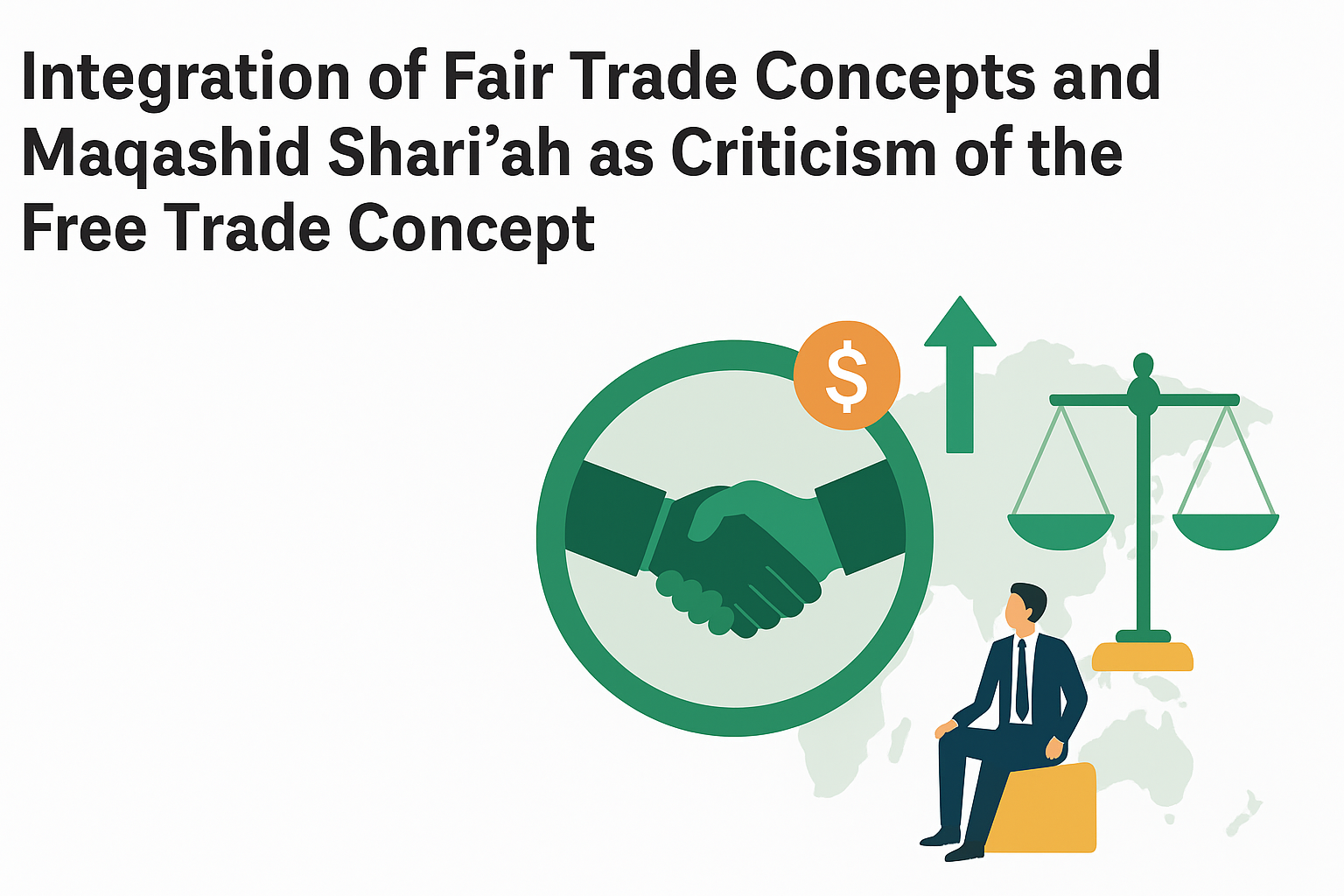
The Integration of Fair Trade Concepts and Maqashid Shari'ah as Criticism of the Free Trade Concept
Abstract
In the era of globalization, the concept of Free Trade has dominated international trade policies, emphasizing liberalization and minimal government intervention. However, there is growing criticism of the negative impacts of Free Trade on justice, the environment, and the economy. This research aims to analyze the integration between the Fair Trade concept and Sharia Economic principles as one of the concepts that can criticize the Free Trade concept. Fair Trade emphasizes fair trade by ensuring that producers in developing countries practice economic fairness. Likewise, the principles of Sharia Economics emphasize distributive justice, transparency, and sustainability. The integration of these two concepts can create a framework that promotes fair, sustainable trade oriented toward community welfare. Drawing on qualitative sources—journals, books, and previous research —this article explains how these two concepts can complement each other in the current global economic context. The results of this research show that integrating Fair Trade and Sharia Economics can provide fairer solutions to address global trade challenges, promote justice, and ensure economic prosperity for all parties involved. This article offers insights into the current international trading system and further explores the potential for cooperation between these two concepts. The integration of Fair Trade and Sharia Economics is not only a critique of the Free Trade concept but also an effort to build a trade system that is fairer, more sustainable, and oriented towards human values and justice.
References
Antoni, S. (2017). Dewesternisasi pendidikan Islam (Studi atas pemikiran Sayyid Muhammad Naquib Al-Attas). Jurnal Ilmiah Al-Jauhari (JIAJ), 2(1), 36–48.
Antweiler, W., Copeland, B. R., & Taylor, M. S. (2001). Is free trade good for the environment? The American Economic Review, 91(4), 877–908.
Astuti, M. (2022). Perdagangan bebas dalam pandangan Islam. IURIS STUDIA: Jurnal Kajian Hukum, 3(2), 228–233.
Bareau, P. (1957). Britain and European free trade. International Journal, 12(2), 128–137.
Barry, D. (2000). Pursuing free trade: Canada, the Western Hemisphere, and the European Union. International Journal, 55(2), 292–300.
Bass, R. (1998). Evaluating environmental justice under the National Environmental Policy Act. Environmental Impact Assessment Review, 18(1), 83–92.
Batubara, Z. (1998). Ekonomi syariah sebagai fondasi ekonomi kerakyatan untuk mencapai Indonesia yang sejahtera. [Unpublished manuscript], 1–11.
Haluddin, & Bahri, S. (2017). Islamisasi ilmu pengetahuan: Pengertian, tujuan, langkah, dan pengaruh. Jurnal STAIDDI Makassar, 1–7.
Huda, M. (2022). Makna dari konsep “litaarafu” dalam perdagangan internasional. Jurnal Ekonomi dan Bisnis Islam, 2(1), 463–470. Universitas Muhammadiyah Yogyakarta.
Hudaya, A. (2019). The implementation analysis of fair trade as an ideal model for corporate social responsibility (A case study at PT Kimia Farma). Journal of Business Ethics, 5(1).
Huringiin, N., & Azfathir, H. N. (2018). The concept of Syed Muhammad Naquib Al-Attas on de-Westernization and its relevance toward the Islamization of knowledge. Kalimah: Jurnal Studi Agama-Agama dan Pemikiran Islam, 16(2), 266–281.
Iswati. (2017). Upaya Islamisasi ilmu pengetahuan dan implikasinya terhadap pendidikan Islam. At-Tajdid, 1, 90–104.
Janah, N., & Ghofur, A. (2018). Maqashid asy-syari‘ah sebagai dasar pengembangan ekonomi Islam. Jurnal Ekonomi Islam, 20(2), 167–192.
Jayn, W. N. (n.d.). Fair trade: Menuju sebuah sistem perdagangan (baru) bagi negara-negara di dunia (pp. 214–232). [Unpublished manuscript].
Kementerian Keuangan Republik Indonesia, Badan Kebijakan Fiskal (BKF). (2012). Laporan hasil kajian: Free Trade Agreement (FTA) dan Economic Partnership Agreement (EPA), dan pengaruhnya terhadap arus perdagangan dan investasi dengan negara mitra.
Krugman, P. R. (1987). Is free trade passé? Journal of Economic Perspectives, 1(2), 131–144.
Listya, A. K. (2013). Konsep fair trade sebagai jawaban atas kritik terhadap liberalisasi perdagangan: Peran Mitra Bali melindungi pengrajin lokal [Undergraduate thesis, Universitas Indonesia]. Universitas Indonesia Repository.
Mahmudah. (2016). Pemikiran Syed Muhammad Naquib Al-Attas. Tsarwah: Jurnal Ekonomi dan Bisnis Islam, 1(1), 95–108.
McKenzie, F. (2014). Faith, fear, and free trade. International Journal, 69(2), 233–245.
Nasution, R. H. (2019). Penerapan prinsip fair trade dalam upaya peningkatan kesejahteraan petani kopi. Jurnal Ekonomi dan Bisnis, 10(1), 51–76.
Pramono, S. (2012). Perjuangan menuju fair trade: Pengalaman APIKRI dalam memediasi pengrajin lokal dan D’Best Furniture dalam mensiasati eco-labeling. Spektrum: Jurnal Ilmu Politik dan Hubungan Internasional, 12(2).
Pramudya, K. (2018). Strategi pengembangan ekonomi syariah melalui penguatan fungsi pengadilan agama dalam penyelesaian sengketa. Jurnal Ekonomi Syariah, 7(1), 35–47.
Ranti, A. (2014). Pengaruh sertifikasi fair trade terhadap kemajuan sektor pertanian kakao di Ghana. JOM FISIP, 2(1), 1–16.
Sarbaini, A., Natsir, N. F., & Haryanti, E. (2022). Integrasi ilmu dan agama sebagai islamisasi ilmu pengetahuan. Ri‘ayah, 7(1), 86–94.
Sholeh. (2017). Islamisasi ilmu pengetahuan (Konsep pemikiran Ismail Raji Al-Faruqi dan Syed Muhammad Naquib Al-Attas). Journal Al-Hikmah, 14(2).
Suherman, A. M. (2008). Perdagangan bebas (free trade) dalam perspektif keadilan internasional. Indonesian Journal of International Law, 5(2), 251–267.
Walton, A. (2010). What is fair trade? Third World Quarterly, 31(3), 431–447.

This work is licensed under a Creative Commons Attribution-ShareAlike 4.0 International License.
Copyright
- The Author and each co-authors transfer the copyright and grant the journal right of publication with the work simultaneously licensed under an International Creative Commons Attribution and ShareAlike 4.0 License that allows others to share the work with an acknowledgement of the work's authorship and initial publication in this journal.
- Authors are able to enter into separate, additional contractual arrangements for the non-exclusive distribution of the journal's published version of the work (e.g., post it to an institutional repository or publish it in a book), with an acknowledgement of its initial publication in this journal.
- Authors should sign copyright transfer agreement when they have approved the final proofs sent by ISLAMIC RESEARCH prior the publication.
Author Guarantee
- The Author (Co-authors) guarantees that the Materials are an original work, submitted only to ISLAMIC RESEARCH, and have not been published previously.
- In case the Materials were written jointly with Co-authors, the Author guarantees that he/she has informed them of the terms of this Agreement and obtained their signatures or written permission to singe on their behalf.
- The Author guarantees as well that:
- The Materials do not contain libelous statements.
- The Materials do not infringe on other persons' rights (including without limitation copyrights, patent rights and the trademark right).
- The Materials do not contain facts or instructions that can cause damage or injury to third parties and their publication dose not cause the disclosure of any secret or confidential information
ISLAMIC RESEARCH is Published by Perhimpunan Intelektual Muslim Indonesia, and licensed under a Creative Commons Attribution-ShareAlike 4.0 International License.
Copyright ©2022.