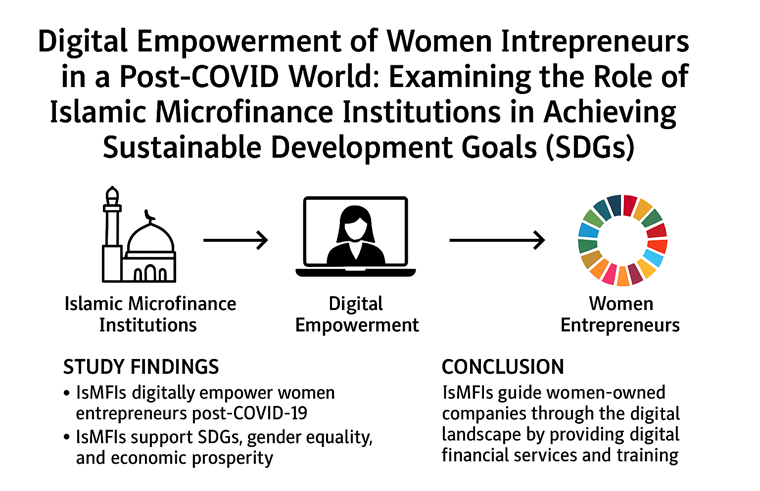
Digital Empowerment of Women Entrepreneurs in a Post-COVID World: Examining the Role of Islamic Microfinance Institutions in Achieving Sustainable Development Goals (SDGs)
Abstract
This pioneering study investigates how Islamic microfinance institutions (IsMFIs) digitally empower women entrepreneurs post-COVID-19 and support the SDGs. It seeks to enlighten policymakers, practitioners, and scholars on the intricate relationship between digital empowerment, women entrepreneurship, and IsMFIs. The study employed rigorous qualitative methodologies to tackle the topic's complexities. Extensive semi-structured interviews were conducted with IsMFI personnel, stakeholders, and digitally benefiting women entrepreneurs. A theme analysis was used to understand participants' viewpoints. Themes and iterative coding were employed to evaluate data. The study explored digital financial inclusion, technology literacy, digital challenges, and IsMFI transformation. Research sheds light on complex processes. According to findings, IsMFIs are instrumental in guiding women-owned companies through the digital landscape by providing digital financial services and training. They advance SDGs, gender equality, and economic prosperity. Gender inequality and internet access can be addressed through innovative collaborations and ideas. Participant biases, a standard limitation in qualitative research, were acknowledged. The study revealed the complex responsibilities of digital empowerment and IsMFIs, opening up new regional and cultural research avenues. The report underscores the need for gender-sensitive digital entrepreneurship policies and solutions. The article advocates for concentrated training and technology to optimize IsMFIs. This study fills a gap in the literature by examining the relationship between IsMFIs, digital empowerment, and women entrepreneurship. The contextualization of digital empowerment in this study underscores its urgency and significance
References
Abebe, S. A. (2023). Refugee entrepreneurship: systematic and thematic analyses and a research agenda. Small Business Economics, 60(1), 315–350. https://doi.org/10.1007/s11187-022-00636-3
Adam, S. B., Al-Aidaros, A. M. H., & Ishak, S. B. (2018). The moderating effect of Islamic work ethics on the relationship between corporate governance and performance of Islamic financial institutions in Nigeria: A proposed framework. Journal of Social Sciences Research, 2018(Special Issue 6), 1041–1048. https://doi.org/10.32861/jssr.spi6.1041.1048
Ahamad, S., Al-Jaifi, H. A. A., & Ehigiamusoe, K. U. (2022). Impact of Intellectual Capital on Microfinance Institutions' Efficiency: The Moderating Role of External Governance. Journal of the Knowledge Economy. https://doi.org/10.1007/s13132-022-00937-8
Ahmed, K., & Khan, R. (2016). Disclosure practices and governance quality: Evidence from microfinance institutions. Journal of Accounting and Organizational Change, 12(3), 325–350. https://doi.org/10.1108/JAOC-02-2015-0014
Akter, A., Ahmad, N., Munira, W., Jaafar, W., Zawawi, D. B., & Islam, M. A. (2018). Empowerment of Women through Self-Help Group Entrepreneurial Activities in Bangladesh. Journal of International Business and Management, 1(1), 1–15.
Alam, Md. K., & Thakur, O. A. (2022). Why Does Bangladesh Require a Centralised Shariah Governance Framework for Islamic Banks? Journal of Nusantara Studies (JONUS), 7(1), 24–42. https://doi.org/10.24200/jonus.vol7iss1pp24-42
Al-Dajani, H. (2022). Refugee women's entrepreneurship: Where from and where to next? International Journal of Gender and Entrepreneurship, 14(4), 489–498. https://doi.org/10.1108/IJGE-06-2022-0090
Al-Enzy, N. S. K., Monem, R., & Nahar, S. (2022). IFRS experience and earnings quality in the GCC region. International Journal of Managerial Finance. https://doi.org/10.1108/IJMF-09-2021-0410
Amrani, O., & Najab, A. (2023). The Impact of Multi-Layer Corporate Governance on Banks' Performance under the GFC and the COVID-19: A Cross-Country Panel Analysis Approach. Journal of Risk and Financial Management, 16(1). https://doi.org/10.3390/jrfm16010015
Antoh, E. F., & Arhin, A. A. (2018). Advancing Sustainable Development Goals (SDGs): An Analysis of How Non-Financial Services of Microfinance Institutions Facilitate Human Capital Development of Clients in Ghana. Journal of Sustainable Development, 11(4), 257. https://doi.org/10.5539/jsd.v11n4p257
Appienti, W. A., & Chen, L. (2020). Empowerment, passion, and job performance: implications from Ghana. International Journal of Manpower, 41(2), 132–151. https://doi.org/10.1108/IJM-10-2018-0348
Araminta, D. V., Qudziyah, Q., & Timur, Y. P. (2022). The Role of Green Sukuk in Realising the Sustainable Development Goals 2030 Agenda. Jurnal Ekonomi Dan Bisnis Islam (Journal of Islamic Economics and Business), 8(2), 251–266. https://doi.org/10.20473/jebis.v8i2.37531
Atsız, O. (2021). Understanding the Role of Refugees' Entrepreneurship Motives and Challenges in Integration: Evidence from the Food Industry. Journal of Economy, Culture, and Society, 0(0), 1–19. https://doi.org/10.26650/jecs2021-863909
Aziz, A., Iqbal, J., Murtza, M. H., Gill, S. A., & Cheema, I. Y. (2022a). Effect of COVID-19 pandemic on women entrepreneurial sustainability: the role of Islamic microfinance institutions. Journal of Economic and Administrative Sciences. https://doi.org/10.1108/jeas-08-2021-0166
Aziz, A., Iqbal, J., Murtza, M. H., Gill, S. A., & Cheema, I. Y. (2022b). Effect of COVID-19 pandemic on women entrepreneurial sustainability: the role of Islamic microfinance institutions. Journal of Economic and Administrative Sciences. https://doi.org/10.1108/jeas-08-2021-0166
Banto, J. M., & Monsia, A. F. (2020). Microfinance institutions, banking, growth, and transmission channel: A GMM panel data analysis from developing countries. Quarterly Review of Economics and Finance. https://doi.org/10.1016/j.qref.2020.06.004
Barth, H., & Zalkat, G. (2021). Refugee entrepreneurship in the agri-food industry: The Swedish experience. Journal of Rural Studies, 86, 189–197. https://doi.org/10.1016/j.jrurstud.2021.06.011
Bhimani, A. (2020). Digital data and management accounting: why we need to rethink research methods. Journal of Management Control, 31(1–2), pp. 9–23. https://doi.org/10.1007/s00187-020-00295-z
Bussin, M., Wöcke, A., & Deysel, B. (2023). The impact of remuneration governance on chief executive officer overpayment. South African Journal of Economic and Management Sciences, 26(1). https://doi.org/10.4102/sajems.v26i1.4860
Chien, F. (2022). The role of corporate governance and environmental and social responsibilities in achieving sustainable development goals in Malaysian logistics companies. Economic Research-Ekonomska Istrazivanja . https://doi.org/10.1080/1331677X.2022.2090407
Dagar, P. (2023). Rethinking skills development and entrepreneurship for refugees: The case of five refugee communities in India. International Journal of Educational Development, p. 101, 102834. https://doi.org/10.1016/j.ijedudev.2023.102834
D’Espallier, B., Goedecke, J., Hudon, M., & Mersland, R. (2017). From NGOs to Banks: Does Institutional Transformation Alter the Business Model of Microfinance Institutions? World Development, 89(April 2014), 19–33. https://doi.org/10.1016/j.worlddev.2016.06.021
Dhungana, B. R., Chapagain, R., & Ashta, A. (2023). Alternative strategies for for-profit, not-for-profit, and state-owned Nepalese microfinance institutions to promote poverty alleviation and women's empowerment. Cogent Economics and Finance, 11(2). https://doi.org/10.1080/23322039.2023.2233778
Dushime, J., & Muathe, S. (2023). Refugee Entrepreneurship: Talent Displacement, Integration and Social-Economic Inclusion in Kenya. International Journal of Entrepreneurship and Business Development, p. 06.
Dzomonda, O., & Fatoki, O. (2018). Evaluating the effect of owners' demographic characteristics on the financial management behavior of rural entrepreneurs in South Africa. Academy of Accounting and Financial Studies Journal, 22(3), 1–11.
García-Pérez, I., Muñoz-Torres, M. J., & Fernández-Izquierdo, M. Á. (2018). Microfinance institutions fostering sustainable development. Sustainable Development, August 2017, 1–14. https://doi.org/10.1002/sd.1731
Haque, T., Siwar, C., Bhuiyan, A. B., & Joarder, M. H. R. (2019). Contributions of AIMS Microfinance to the economic empowerment (EE) of women borrowers in Malaysia. Economics and Sociology, 12(4), 227–242. https://doi.org/10.14254/2071-789X.2019/12-4/15
Hejrati, Z. S., Gaim, M., Eesley, C. E., & Dang, T. K. (2021). Use of MOOC and Digital Technologies to Study Effects of Liability of Foreignness on Venture Formation in Forced Immigration-Case Study of Refugee Entrepreneurship in Ethiopia. 2021 IEEE 4th International Conference on Information Systems and Computer-Aided Education, ICISCAE 2021, pp. 54–61. https://doi.org/10.1109/ICISCAE52414.2021.9590736
Hossain, S., Galbreath, J., Hasan, M. M., & Randøy, T. (2020). Does competition enhance the double-bottom-line performance of microfinance institutions? Journal of Banking and Finance, p. 113, 105765. https://doi.org/10.1016/j.jbankfin.2020.105765
Hossain, S., Galbreath, J., Hasan, M. M., & Randøy, T. (2023). All in the family? The impact of founder directors and family governance on microfinance institutions' social performance. Corporate Governance: An International Review. https://doi.org/10.1111/corg.12528
Islam, R., & Ahmad, R. (2020). Muḍārabah and mushārakah as micro-equity finance: perception of Selangor's disadvantaged women entrepreneurs. ISRA International Journal of Islamic Finance, 12(2), 217–237. https://doi.org/10.1108/IJIF-04-2018-0041
Jan, A. A., Lai, F. W., Asif, M., Akhtar, S., & Ullah, S. (2022). Embedding sustainability into bank strategy: implications for reporting on the Sustainable Development Goals. International Journal of Sustainable Development and World Ecology. https://doi.org/10.1080/13504509.2022.2134230
Jan, A., Mata, M. N., Albinsson, P. A., Martins, J. M., Hassan, R. B., & Mata, P. N. (2021). Alignment of Islamic banking sustainability indicators with sustainable development goals: Policy recommendations for addressing the COVID-19 pandemic. Sustainability (Switzerland), 13(5), 1–38. https://doi.org/10.3390/su13052607
Jan, A., Rahman, H. U., Zahid, M., Salameh, A. A., Khan, P. A., Al-Faryan, M. A. S., Che Aziz, R. B., & Ali, H. E. (2023). Islamic corporate sustainability practices index aligned with SDGs towards better financial performance: Evidence from the Malaysian and Indonesian Islamic banking industry. Journal of Cleaner Production, 405. https://doi.org/10.1016/j.jclepro.2023.136860
Kendo, S., & Tchakounte, J. (2022). The drivers of the financial integration of microfinance Institutions: Do financial development, agency costs, and microfinance performance matter? Quarterly Review of Economics and Finance, 84, 128–142. https://doi.org/10.1016/j.qref.2022.01.016
Khalaf, L. S., & Saqfalhait, N. I. (2020). Microfinance: An Emerging Tool for Women's Economic Empowerment. Entrepreneurial Opportunities, 37–52. https://doi.org/10.1108/978-1-83909-285-520201003
Khan, T., & Badjie, F. (2022). Islamic blended finance for the circular economy, impactful SMEs to achieve SDGs. Singapore Economic Review, 67(1), 219–244. https://doi.org/10.1142/S0217590820420060
Klemens Katterbauer & Philippe Moschetta. (2022). A robo-advisory framework for Islamic and Environmental, Social and Governance (ESG) compliance – A benchmark study on the S&P 500 stock index. The Journal of Muamalat and Islamic Finance Research, 34–46. https://doi.org/10.33102/jmifr.v19i1.408
Kundu, S. C., Kumar, S., & Gahlawat, N. (2019). Empowering leadership and job performance: the mediating role of psychological empowerment. Management Research Review, 42(5), 605–624. https://doi.org/10.1108/MRR-04-2018-0183
Lanzara, F. (2021). Islamic Finance and Sustainable Development Goals. A bibliometric analysis from 2000 to 2021. European Journal of Islamic Finance, pp. 1–19. https://doi.org/10.13135/2421-2172/5765
Lawhaishy, Z. B., & Othman, A. H. A. (2023). Introducing an Islamic equity-based microfinance model for MSMEs in the State of Libya. Qualitative Research in Financial Markets, 15(1), 1–28. https://doi.org/10.1108/QRFM-01-2021-0017
Lejano, R. P., Rahman, M. S., & Kabir, L. (2020). Risk Communication for Empowerment: Interventions in a Rohingya Refugee Settlement. Risk Analysis, 40(11), 2360–2372. https://doi.org/10.1111/risa.13541
Lopatta, K., Tchikov, M., Jaeschke, R., & Lodhia, S. (2017). Sustainable Development and Microfinance: The Effect of Outreach and Profitability on Microfinance Institutions' Development Mission. Sustainable Development, 25(5), 386–399. https://doi.org/10.1002/sd.1663
Lyne, I., Ngin, C., & Santoyo-Rio, E. (2018). Understanding social enterprise, social entrepreneurship, and the social economy in rural Cambodia. Journal of Enterprising Communities, 12(3), 278–298. https://doi.org/10.1108/JEC-11-2016-0041
Mamun, A. Al, Ibrahim, M. A. H. Bin, Muniady, R., Ismail, M. Bin, Nawi, N. B. C., & Nasir, N. A. B. M. (2018). Development programs, household income, and economic vulnerability. World Journal of Entrepreneurship, Management and Sustainable Development, 14(4), 353–366. https://doi.org/10.1108/wjemsd-01-2018-0008
Mazlan, P. N. B. M., Hersh, N. F., Masron, T. A., & Malim, N. A. K. (2023). Islamic finance and governance indicators: empirical evidence from Islamic finance-permitting countries. International Journal of Disclosure and Governance. https://doi.org/10.1057/s41310-023-00177-5
Mia, M. A., Ahmad, N. H., & Halim, H. A. (2022). The impact of employee turnover on the financial performance of microfinance institutions: A global evidence. Business and Society Review, 127(4), 863–889. https://doi.org/10.1111/basr.12291
Mnif, Y., & Tahari, M. (2021). The effect of Islamic banks' specific corporate governance mechanisms on compliance with AAOIFI governance standards. Journal of Islamic Accounting and Business Research, 12(1), 21–43. https://doi.org/10.1108/JIABR-11-2018-0188
Muhmad, S. N., Muhamad, R., & Sulong, F. (2021). Sustainable Development Goals and Islamic Finance: An Integrated Approach for Islamic Financial Institutions. Indonesian Journal of Sustainability Accounting and Management, 5(1). https://doi.org/10.28992/ijsam.v5i1.286
Mukhlisin, M., Tamanni, L., & Azid, T. (2020). Contribution of Islamic Microfinance Studies in Achieving Sustainable Development Goals. Enhancing Financial Inclusion Through Islamic Finance, (July), 51–79. https://doi.org/10.1007/978-3-030-39935-1
Mumi, A., Joseph, G., & Quayes, S. (2020). Organisational and legal institutions, and the performance of microfinance institutions as hybrid entities. Journal of Accounting and Organizational Change, 16(3), 285–309. https://doi.org/10.1108/JAOC-02-2020-0022
Mutamimah, M., Zaenudin, Z., & Bin Mislan Cokrohadisumarto, W. (2022). Risk management practices of Islamic microfinance institutions to improve their financial performance and sustainability: a study on Baitut Tamwil Muhammadiyah, Indonesia. Qualitative Research in Financial Markets, 14(5), 679–696. https://doi.org/10.1108/QRFM-06-2021-0099
Nadzri, F. A. A., Omar, N., & Rahman, R. A. (2018). Enterprise governance of micro-entrepreneurs in Malaysia: Comparison between the Amanah Ikhtiar Malaysia and Asnaf's economic development program. Global Journal Al-Thaqafah, 2018(January), 25–40. https://doi.org/10.7187/gjatsi2018-02
Naouar Damak Anissa. (2018). Toward A Comprehensive Sharia Governance Framework for Islamic Finance: A Contribution to the Debate. International Journal of Management Sciences and Business Research, 7(11), 14–26. http://www.ijmsbr.com
Ogunsola, K. O., Sarif, S. M., & Fontaine, R. A. (2020). Islamic Performance Instrument (IPI): An Alternative Servant Leadership (SL) tool for Sustainable Development Goals (SDGs). International Journal of Islamic Business Ethics, 5(1), 1. https://doi.org/10.30659/ijibe.5.1.1-20
Okoe, A. F., & Boateng, H. (2016). Assessing the CSR information needs of Microfinance institutions (IsMFIs) customers. Journal of Information, Communication and Ethics in Society, 14(3), 272–287. https://doi.org/10.1108/JICES-09-2015-0028
Olorede, T., Abogun, S., & Olowookere, J. (2022). Executive Compensation, Corporate Governance and Financial Reporting Quality: Evidence from listed firms in Nigeria. Istanbul Management Journal, 0(93), 1–19. https://doi.org/10.26650/imj.2022.93.001
Omercic, J. (2022). The Integration of Knowledge (IoK) Methodological Approach to Reforming the Development of Islamic Economics, Banking, and Finance (IEBF), considering Maqasid (Objectives) and Sustainable Development Goals (SDGs). Global Review of Islamic Economics and Business, 9(2), 039. https://doi.org/10.14421/grieb.2021.092-04
Pahlevi, R. W. (2023). Mapping of Islamic corporate governance research: a bibliometric analysis. In Journal of Islamic Accounting and Business Research (Vol. 14, Issue 4, pp. 538–553). Emerald Publishing. https://doi.org/10.1108/JIABR-12-2021-0314
Parwez, S., & Patel, R. (2022). Augmenting women's empowerment: a systematic literature review on microfinance-led developmental interventions. In Journal of Global Responsibility (Vol. 13, Issue 3, pp. 338–360). Emerald Group Holdings Ltd. https://doi.org/10.1108/JGR-01-2021-0005
Qin, S. (2023). Positionality of refugee business support and hospitality building under cognitive dissonance theory: an enterprising route of refugee entrepreneurship. Journal of Enterprising Communities, 17(2), 242–260. https://doi.org/10.1108/JEC-04-2021-0055
Remer, L., & Kattilakoski, H. (2021). Microfinance institutions' operational self-sufficiency in sub-Saharan Africa: empirical evidence. International Journal of Corporate Social Responsibility, 6(1). https://doi.org/10.1186/s40991-021-00059-5
Richey, M., Brooks, J., & Ravishankar, M. N. (2022). Building self-determination of disadvantaged groups: insights from an entrepreneurship-focused program for refugees. International Journal of Entrepreneurial Behaviour and Research, 28(7), 1828–1850. https://doi.org/10.1108/IJEBR-10-2021-0806
Roy, P., & Pati, A. P. (2019). Double bottom line commitments of microfinance: evidence from Indian institutions. International Journal of Social Economics, 46(1), 116–131. https://doi.org/10.1108/IJSE-08-2016-0240
Sachs, J. D., Woo, W. T., Yoshino, N., & Taghizadeh-Hesary, F. (2019). Importance of Green Finance for Achieving Sustainable Development Goals and Energy Security. Handbook of Green Finance, 3–12. https://doi.org/10.1007/978-981-13-0227-5_13
Schmich, M., & Mitra, J. (2023). Can Entrepreneurship Enable the Economic and Social Integration of Refugees? A Comparison of the Economic, Social, and Policy Context for Refugee Entrepreneurship in the UK and Germany. Journal of Entrepreneurship and Innovation in Emerging Economies, 9(1), 9–32. https://doi.org/10.1177/23939575221146848
Shahid, M., Sulub, Y. A., Mohtesham, M. M. J., & Abdullah, M. (2023). Analyzing the commonalities between Islamic social finance and sustainable development goals. International Journal of Ethics and Systems. https://doi.org/10.1108/IJOES-04-2022-0082
Shire, S., & Azrak, T. (2023). The Impact of Covid-19 on Microfinance Institutions in Somalia. İslam Ekonomisi Dergisi, 3(1), 69–84. https://doi.org/10.55237/jie.1146244
Singh, K. (2023). Social performance, financial risk, and financial performance in microfinance institutions. International Journal of Bank Marketing. https://doi.org/10.1108/IJBM-01-2023-0005
Tadele, H., Roberts, H., & Whiting, R. (2022). Microfinance institutions' risk and governance in Sub-Saharan Africa. International Journal of Social Economics, 49(3), 449–469. https://doi.org/10.1108/IJSE-10-2020-0719
Tadele, H., Whiting, R. H., & Roberts, H. (2018). Transparency and microfinance institutions' risk in Sub-Saharan Africa. International Journal of Corporate Governance, 9(2), 201. https://doi.org/10.1504/ijcg.2018.10011965
Tchakoute-Tchuigoua, H., & Soumaré, I. (2019). The effect of loan approval decentralisation on microfinance institutions' outreach and loan portfolio quality. Journal of Business Research, 94(September 2018), 1–17. https://doi.org/10.1016/j.jbusres.2018.09.021
Toivonen, A. (2023). Refugee economic self-reliance practices: How institutional intermediations negotiate opportunities for refugee employment and entrepreneurship. Geoforum, p. 140. https://doi.org/10.1016/j.geoforum.2023.103700
Trimulato, T., Muhlis, M., Fajrin, F., Hamid, S., & Putra, T. W. (2021). Service Excellent for Islamic Micro Financial Institution During Covid-19 Pandemic. IQTISHADUNA: Jurnal Ilmiah Ekonomi Kita, 10(1), 48–61. https://doi.org/10.46367/iqtishaduna.v10i1.318
Uddin, M. N. (2020). Role of Islamic Microfinance Institutions for Sustainable Development Goals in Bangladesh. Journal of International Business and Management, pp. 1–12. https://doi.org/10.37227/jibm-2020-64
Uddin, M. N., Hamdan, H., Kassim, S., Embi, N. A. C., & Saad, N. B. M. (2020). Role of Islamic Microfinance Institutions for Sustainable Development Goals in Bangladesh. International Journal of Business and Management, 3(1), 0–12. https://doi.org/10.37227/jibm-2020-64
Umar, U. H., Baita, A. J., Haron, M. H. Bin, & Kabiru, S. H. K. (2021). The potential of Islamic social finance to alleviate poverty in the era of COVID-19: the moderating effect of ethical orientation. International Journal of Islamic and Middle Eastern Finance and Management. https://doi.org/10.1108/IMEFM-07-2020-0371
Usman, S., Tasmin, R., Tun, U., & Onn, H. (2016). The Relevance of Islamic Micro-finance in Achieving the Sustainable Development Goals. International Journal of Latest Trends in Finance & Economic Sciences IJLTFES, 6(August).
Waage, J., Yap, C., Bell, S., Levy, C., Mace, G., Pegram, T., Unterhalter, E., Dasandi, N., Hudson, D., Kock, R., Mayhew, S. H., Marx, C., & Poole, N. (n.d.). Governing Sustainable Development Goals : interactions, infrastructures, and institutions. 79–88.
Zehra, K., & Usmani, S. (2021). Not without family: refugee family entrepreneurship and economic integration process. Journal of Enterprising Communities. https://doi.org/10.1108/JEC-03-2020-0044
Zighan, S. (2020). Challenges faced by necessity entrepreneurship: the case of Syrian refugees in Jordan. Journal of Enterprising Communities, 15(4), 531–547. https://doi.org/10.1108/JEC-09-2020-0168

This work is licensed under a Creative Commons Attribution-ShareAlike 4.0 International License.
Copyright
- The Author and each co-authors transfer the copyright and grant the journal right of publication with the work simultaneously licensed under an International Creative Commons Attribution and ShareAlike 4.0 License that allows others to share the work with an acknowledgement of the work's authorship and initial publication in this journal.
- Authors are able to enter into separate, additional contractual arrangements for the non-exclusive distribution of the journal's published version of the work (e.g., post it to an institutional repository or publish it in a book), with an acknowledgement of its initial publication in this journal.
- Authors should sign copyright transfer agreement when they have approved the final proofs sent by ISLAMIC RESEARCH prior the publication.
Author Guarantee
- The Author (Co-authors) guarantees that the Materials are an original work, submitted only to ISLAMIC RESEARCH, and have not been published previously.
- In case the Materials were written jointly with Co-authors, the Author guarantees that he/she has informed them of the terms of this Agreement and obtained their signatures or written permission to singe on their behalf.
- The Author guarantees as well that:
- The Materials do not contain libelous statements.
- The Materials do not infringe on other persons' rights (including without limitation copyrights, patent rights and the trademark right).
- The Materials do not contain facts or instructions that can cause damage or injury to third parties and their publication dose not cause the disclosure of any secret or confidential information
ISLAMIC RESEARCH is Published by Perhimpunan Intelektual Muslim Indonesia, and licensed under a Creative Commons Attribution-ShareAlike 4.0 International License.
Copyright ©2022.