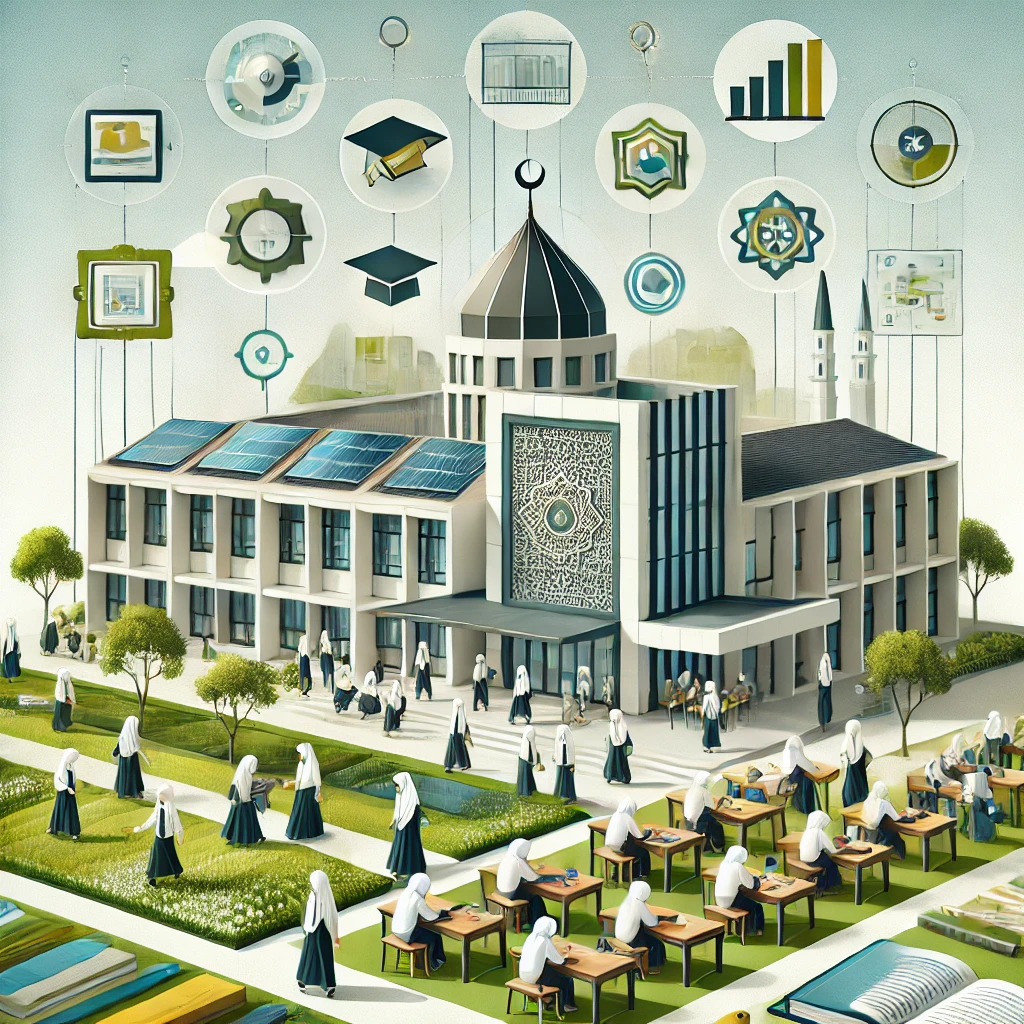
Aligning Educational Facilities with Curriculum Demands: Insights from Integrated Islamic Primary Schools in West Java
Abstract
The purpose of this study is to investigate the appropriateness and condition of educational facilities in compliance with Ministerial Regulation No. 24 of 2007, as well as the relationship between these facilities and the curriculum at Integrated Islamic Primary Schools (SDIT) in Bandung, West Java. In this study, nine full-day SDITs were reviewed using a qualitative methodology that included snowball sampling. According to the findings, although the majority of schools are able to meet the infrastructure standards, there are disparities in the conditions of the facilities, such as differences in classroom size, ventilation, and library resources, which show that there is a need for changes. Furthermore, the variety of curricular applications, which can range from national to international systems, has a considerable impact on the spatial organisation of school facilities as well as the functional criteria that must be met. It is necessary to have appropriate infrastructure assistance in order to facilitate the integration of various curricular aspects in order to cultivate an effective learning environment that is respectful of Islamic educational ideals. According to the findings of this study, improving facility standards and bringing them into closer alignment with the requirements of a wide variety of curricula can have a considerable positive impact on educational outcomes.
References
Azalea, A. S., & Salayanti, S. (2024). Perancangan ulang madrasah Mu ’allimaat. 11(1), 2125–2140.
Az-Zahra, S. S. (2022). Perancangan ulang interior Sekolah Islam Terpadu Insan Sejahtera Boarding School Sumedang dengan pendekatan human behaviour. 10(3), 5257–5276.
Cho, J. Y., & Suh, J. (2020). Interior design. In S. Pritzker & M. B. Runco (Eds.), Encyclopedia of Creativity (3rd ed., pp. 685–694). Academic Press. https://doi.org/10.1016/B978-0-12-809324-5.23600-6
Creswell, J. W., & Clark, V. L. P. (2017). Designing and conducting mixed methods research. SAGE Publications. https://books.google.co.id/books?id=uRZjswEACAAJ
Earthman, G. I. (n.d.). The relationship between the attitudes students have about their school building and their achievement.
Earthman, G. I., & Lemasters, L. K. (2009). Teacher attitudes about classroom conditions. Journal of Educational Administration, 47(3), 323–335.
Etikan, I., Alkassim, R., & Abubakar, S. (2016). Comparison of snowball sampling and sequential sampling technique. Biometrics and Biostatistics International Journal, 3(1), 55.
Firmansyah, R., Ismail, S., Utaberta, N., Yuli, G. N., & Shaari, N. (2020). Student’s perception of common rooms in Daarut Tauhid Tahfidz Islamic Boarding School, Bandung. In EduARCHsia & Senvar 2019 International Conference (EduARCHsia 2019) (Vol. 192, Issue EduARCHsia 2019). Atlantis Press. https://doi.org/10.2991/aer.k.200214.012
Flick, U. (2018). An introduction to qualitative research. SAGE Publications. https://books.google.co.id/books?id=o5l7DwAAQBAJ
Hakim, I. N. (2014). Pembelajaran tematik-integratif di SD/MI dalam kurikulum 2013. INSANIA: Jurnal Pemikiran Alternatif Kependidikan, 19(1), 46–59.
Harisnur, F. (2021). Pengembangan kurikulum pendidikan agama Islam (PAI) Jaringan Sekolah Islam Terpadu (JSIT) tingkat sekolah dasar. Genderang Asa: Journal of Primary Education, 2(2), 52–65.
Hashimov, E. (2015). Qualitative data analysis: A methods sourcebook and the coding manual for qualitative researchers: Matthew B. Miles, A. Michael Huberman, and Johnny Saldaña. Thousand Oaks, CA: SAGE, 2014. 381 pp. Johnny Saldaña. Thousand Oaks, CA: SAGE, 2013. 303 pp. Taylor & Francis.
Heale, R., & Twycross, A. (2015). Validity and reliability in quantitative studies. Evidence-Based Nursing, 18(3), 66–67. https://doi.org/10.1136/eb-2015-102129
Hidayat, C., Hanafiah, U. I. M., & Firmansyah, R. (2018). Redesain interior pondok pesantren modern Putra Sabilunnajah di Kabupaten Bandung, Jawa Barat. EProceedings of Art & Design, 5(3), 3548–3560.
Kurniawan, F. A., & Cardiah, T. (2024). Optimalisasi desain interior fasilitas pendidikan di Pondok Pesantren Al-Basyariyah 2 Bandung melalui pendekatan human behaviour: Sebuah studi. 11(1), 1449–1466.
Ma’rufah, A. (2020). Implementasi kurikulum mata pelajaran pendidikan agama Islam (upaya mewujudkan budaya religius di sekolah). Edukasia: Jurnal Pendidikan dan Pembelajaran, 1(1), 125–136.
Matthew, B., & Michael, H. A. (1994). Qualitative data analysis. Sage Pub.
Millet, M. (2009). Sources: Encyclopedia of survey research methods. Reference & User Services Quarterly, 49, 196–197. https://doi.org/10.5860/rusq.49n2.196
Nurkhopipah, N., Firmansyah, R., & Laksitarini, D. N. (2022). Perancangan ulang interior Sekolah Menengah Atas Darul Hikam, Dago dengan pendekatan brand identity. 8(6), 4701–4714.
Omer, S. (2012). The concepts of God, man, and the environment in Islam: Implications for Islamic architecture. Journal of Islamic Architecture, 2(1), 1–12. https://doi.org/10.18860/jia.v2i1.1778
Parker, C., Scott, S., & Geddes, A. (2019). Snowball sampling. SAGE Research Methods Foundations.
Putri, D. D., & Firmansyah, R. (2018). Analisa bentuk furnitur sebagai media duduk pada. 3(2), 12–22.
Rakista, P. M. (2023). Implementasi Permendikbud Nomor 24 Tahun 2007 tentang standar sarana dan prasarana pendidikan. Sawala: Jurnal Administrasi Negara, 11(1), 31–41.
Rangga, F., Nangkula, U., Nazlina, S., Sumarni, I., & Ratri, W. (2020). Evaluation of universal design requirements application in public mosques in Bandung. Malaysian Journal of Public Health Medicine, 20(Special1), SE-Articles. https://doi.org/10.37268/mjphm/vol.20/no.Special1/art.692
Syahidah, J., Firmansyah, R., & Laksitarini, N. (2021). Perancangan interior Pesantren Sabilunnajah Putri di Solokanjeruk Kabupaten Bandung Jawa Barat. EProceedings of Art & Design, 8(6), 4367–4377.
Wiyatasari, R. R., Firmansyah, R., Irma, U., & Hanafiah, M. (2022). Perancangan interior Al Azhar International Islamic Boarding School Tangerang Putri dengan pendekatan arsitektur Islam. 8(6), 4215–4230.
Yusanto, M. I. (2001). Menggagas kembali konsep sistem pendidikan Islam. Thariqu Izzah: Bandung.
Yusof, Z. B. (2011). Islam and architecture. Islam and Built Environment, June, 11–18.
Yusuf, W. F. (2018). Implementasi kurikulum 2013 (K-13) pada mata pelajaran pendidikan agama Islam sekolah dasar (SD). Jurnal Al-Murabbi, 3(2), 263–278.

This work is licensed under a Creative Commons Attribution-ShareAlike 4.0 International License.
Copyright
- The Author and each co-authors transfer the copyright and grant the journal right of publication with the work simultaneously licensed under an International Creative Commons Attribution and ShareAlike 4.0 License that allows others to share the work with an acknowledgement of the work's authorship and initial publication in this journal.
- Authors are able to enter into separate, additional contractual arrangements for the non-exclusive distribution of the journal's published version of the work (e.g., post it to an institutional repository or publish it in a book), with an acknowledgement of its initial publication in this journal.
- Authors should sign copyright transfer agreement when they have approved the final proofs sent by ISLAMIC RESEARCH prior the publication.
Author Guarantee
- The Author (Co-authors) guarantees that the Materials are an original work, submitted only to ISLAMIC RESEARCH, and have not been published previously.
- In case the Materials were written jointly with Co-authors, the Author guarantees that he/she has informed them of the terms of this Agreement and obtained their signatures or written permission to singe on their behalf.
- The Author guarantees as well that:
- The Materials do not contain libelous statements.
- The Materials do not infringe on other persons' rights (including without limitation copyrights, patent rights and the trademark right).
- The Materials do not contain facts or instructions that can cause damage or injury to third parties and their publication dose not cause the disclosure of any secret or confidential information
ISLAMIC RESEARCH is Published by Perhimpunan Intelektual Muslim Indonesia, and licensed under a Creative Commons Attribution-ShareAlike 4.0 International License.
Copyright ©2022.